

About Wayang

How a Puppet Is Made

From a raw buffalo hide to a puppet ready for the screen. Scroll to follow each step, with the Wisanggeni puppet as the example.

The order and the terms on this page follow common practice among carvers of the Surakarta style. Every carver and workshop may have their own ways and words.

The 3D scene for this step is being made

  1. Step 1 of 11I

    Buffalo hide

    kulitꦏꦸꦭꦶꦠ꧀

    Wayang kulit purwa puppets are made of buffalo hide. The carver chooses a sheet of even thickness, with few scars, large enough for one figure; a large figure such as a giant takes almost a whole hide.

    Raw hide is hairy, fatty, stiff and opaque. The steps that follow turn it into a thin sheet that is strong, flat and lets the light of the blencong lamp through.

    Materials
    raw buffalo hide
  2. Step 2 of 11II

    Soaking and stretching

    The hide is soaked in water until it is supple. It is then stretched on a frame of bamboo or wood, tied with cord all round, and pulled tighter little by little until it is taut and flat.

    It dries on the frame. Drying under tension is what keeps the sheet flat and stops it from curling later.

    Tools
    bamboo or wooden frame, cord
    Materials
    water
  3. Step 3 of 11III

    Scraping off hair and fat

    ngerokꦔꦼꦫꦺꦴꦏ꧀

    While still on the frame, the hide is scraped with a scraping knife: the hair on one side, the remains of flesh and fat on the other, a little at a time, until it is equally thick everywhere.

    Scraped hide is ivory yellow and slightly translucent. Once dry, the surface is smoothed so that it can be drawn on.

    Tools
    scraping knife, whetstone or sandpaper
  4. Step 4 of 11IV

    Drawing the pattern

    nyorekꦚꦺꦴꦫꦺꦏ꧀

    The hide comes off the frame and the figure is drawn on it. Carvers usually trace a pattern from an existing puppet or drawing, so that size and shape follow the conventions: the height of the body, the set of the shoulders, the headdress, the stance of the legs.

    Not only the outline is drawn, but also the inner lines that will guide the carving and the painting. The two arms are drawn apart from the body.

    Tools
    pencil or scriber, pattern
  5. Step 5 of 11V

    Carving

    natahꦤꦠꦃ

    The hide is laid on a block of hard wood (pandhukan) and pierced with a tatah, a small chisel struck with a wooden mallet (ganden). A carver owns dozens of tatah with different blades, straight, curved or round, each for one shape of hole.

    The holes are set out in named patterns, such as bubukan (round dots), inten-intenan (like little diamonds) and mas-masan. Hair, headdress, cloth and jewellery each have their own carving.

    Last, the figure is cut out of the rest of the hide along its outline. Carving is the longest step; one puppet can take weeks.

    The carving in this picture is the real carving of the Wisanggeni puppet, photographed in front of a white screen.

    Tools
    tatah of many sizes, ganden (wooden mallet), pandhukan (wooden block)
  6. Step 6 of 11VI

    Ground coat

    Before painting, the whole puppet gets a white ground coat. Traditionally it is made of bone powder mixed with a glue (ancur); today many use a ready-made primer.

    The ground seals the pores of the hide, makes the colours brighter and helps them last.

    Tools
    brush
    Materials
    bone powder, ancur (glue)
  7. Step 7 of 11VII

    Painting

    nyunggingꦚꦸꦔ꧀ꦒꦶꦁ

    The painter lays the colours in steps, from the lightest to the darkest, so that every area shades from one tone to the next.

    Some parts, such as the body, the jewellery and the headdress, are gilded with prada: gold leaf in the past, often imitation gold powder today. Last come fine lines and small dots in black ink that sharpen the shapes.

    The colour of the face and body is chosen for the character’s nature.

    What the face colours mean →

    Tools
    fine brushes, pen
    Materials
    paint, prada (gold), black ink
  8. Step 8 of 11VIII

    Horn rods

    gapitꦒꦥꦶꦠ꧀

    The rods are made of buffalo horn. The horn is heated over a fire until it bends, then straightened and shaped little by little, pared down and polished until it shines.

    A puppet needs one main rod that holds the body from the feet to the head, with a pointed end that is stuck into a banana trunk (gedebog), and two small rods (tuding) to move the hands.

    Tools
    fire, paring knife, sandpaper
    Materials
    buffalo horn
  9. Step 9 of 11IX

    The parts of a puppet

    Before it is put together, a puppet is: the body with head and legs in one sheet, two upper arms, two forearms with their hands, gegel pins for the joints, the main rod and two arm rods.

    Every part has been carved and painted on its own. The labels on the picture name each part.

  10. Step 10 of 11X

    Putting it together

    The upper arms are joined to the shoulders, and the forearms to the elbows, with gegel: small pins of horn, bone or metal, riveted so that the joints turn.

    The arm rods are tied to the palms with thread, then the main rod is clamped to the body and tied with thread in several places. The puppet can now move as it does in the dalang’s hands.

    Tools
    gegel, thread
  11. Step 11 of 11XI

    A finished puppet

    wayangꦮꦪꦁ

    This Wisanggeni is finished. In front of the blencong its carving becomes a patterned shadow on the screen, while the painting is seen by those sitting on the dalang’s side.

About Wayang

How to read a puppet

A shadow puppet can be read. The headdress, the face, its colour, the eyes, the posture and the carving tell you who the figure is and what it is like. This page shows how, with a 3D puppet as the example.

Puppet No. 2Loading the 3D puppet…
  1. Part 1 of 14I

    The parts of a puppet

    A wayang kulit purwa puppet is cut from one sheet of buffalo hide, then carved (tatah) and painted (sungging). Head, body and legs are one piece; the two arms are made separately and joined at shoulder and elbow with pins (gegel), so they can move. A central horn rod (gapit) holds the body from below up to the head, and each hand has a small rod for moving the arm.

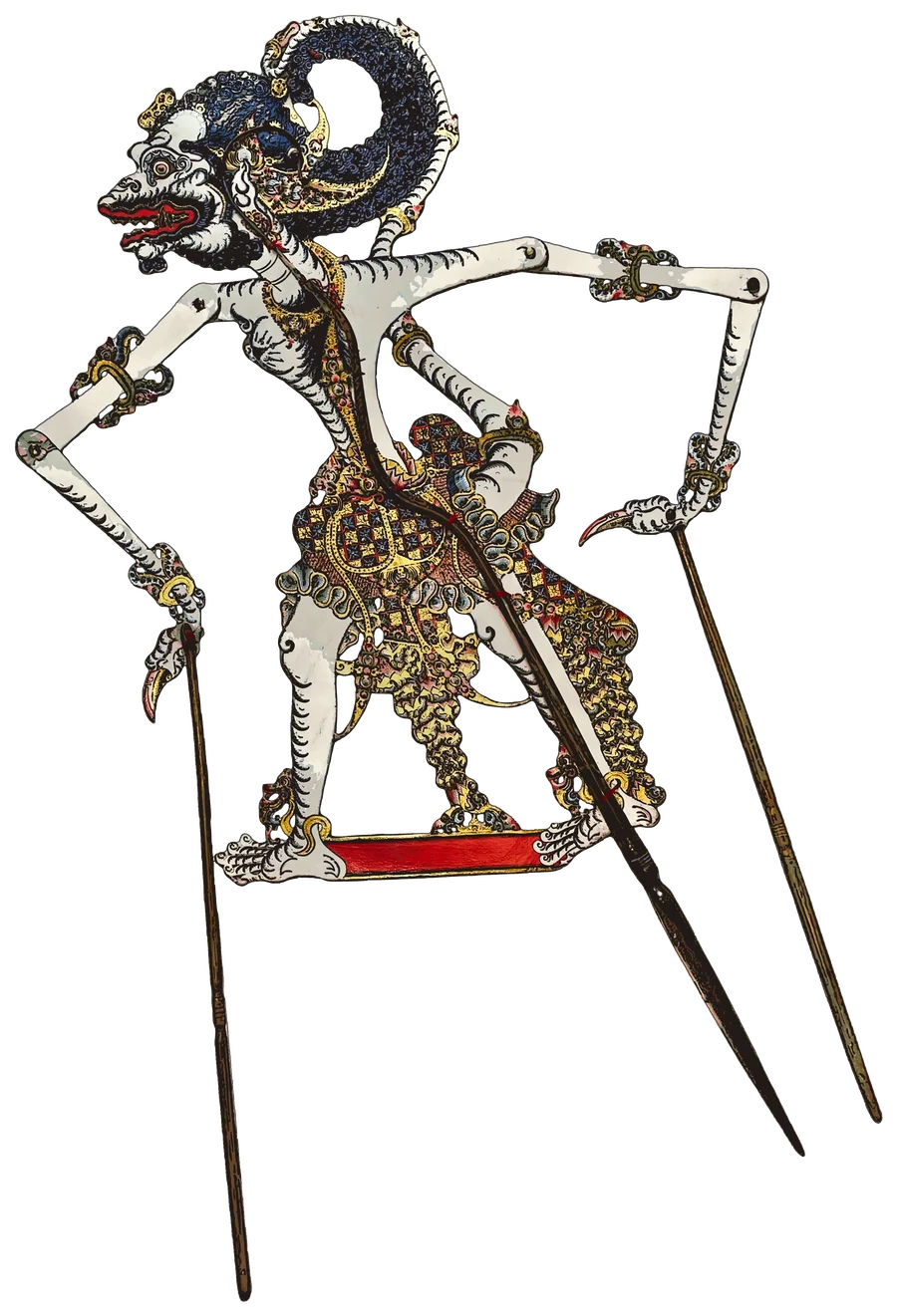
    The parts marked on the puppet: Headdress (makutha), Face (wanda), Hair (rambut), Pancanaka claws (kuku pancanaka), Dress (dodot), Ground (palemahan), Main gapit (gapit), Tuding (tuding).

    Tap a label on the puppet to zoom in on that part. Drag a rod or a hand to move the arms. No. 2 · Anoman →

  2. Part 2 of 14II

    Headdress

    makutha

    Anuman's crown and head ornament are chiselled from the same piece of hide as the face. Its shape and gold detailing mark his rank as Rama's envoy.

  3. Part 3 of 14III

    Face

    wanda

    The white monkey's face is built from a strong profile: round eyes, a long nose and a toothy mouth. The white colour and facial shape immediately identify Anuman.

  4. Part 4 of 14IV

    Hair

    rambut

    The black curled hair behind the head is pierced with fine openings, so the blencong lamp shines through and casts a textured shadow on the screen.

  5. Part 5 of 14V

    Pancanaka claws

    kuku pancanaka

    The long, sharp claws at the hand are the pancanaka, Anuman's signature weapon. In performance, the hand and its rod make them look as if they grip or point.

  6. Part 6 of 14VI

    Dress

    dodot

    Anuman's lower garment and waist ornament carry batik motifs and gold detailing. Fine perforations keep the pattern readable when the puppet appears as a shadow.

  7. Part 7 of 14VII

    Ground

    palemahan

    The red strip between the feet is the puppet's ground. The wide stance gives a firm, ready posture, fitting Anuman as commander of the monkey army.

  8. Part 8 of 14VIII

    Main gapit

    gapit

    The main gapit grips the puppet through the middle and ends in a point. The dalang holds it to plant the puppet in the banana trunk or lift it from the screen.

  9. Part 9 of 14IX

    Tuding

    tuding

    The thin rod joined to the right hand is the tuding. Pulling it lets the dalang change the arm's pose without holding the puppet with the same hand.

  10. Part 10 of 14X

    Wanda

    Wanda is the face and bearing that show a character’s mood. One character can be made in several wanda, for calm, sad or angry scenes, and the dalang picks the one that suits the scene.

    The differences can be small: a slightly different tilt of the head, the shape of the eyes, the curve of the shoulders or the face colour. That is why the wanda is recorded together with the character’s name, as with the puppets in this collection.

    Face wanda · The white monkey's face is built from a strong profile: round eyes, a long nose and a toothy mouth. The white colour and facial shape immediately identify Anuman.

  11. Part 11 of 14XI

    Face colour

    The face colour does not show skin colour but character and mood. As a rule of thumb:

    • black: calm, mature and steadfast;
    • gold (prada): noble and beautiful, often the most formal look;
    • red: brave, quick to anger, or ruled by desire;
    • white: young, pure or honest;
    • blue and other colours: used for particular figures, including many sabrangan (overseas) kings and ogres.

    These meanings are a guide, not a fixed rule: the same colour can mean different things in different gagrag and from different makers.

    Face wanda · The white monkey's face is built from a strong profile: round eyes, a long nose and a toothy mouth. The white colour and facial shape immediately identify Anuman.

  12. Part 12 of 14XII

    Eyes and nose

    The shape of the eyes and nose sets refined figures apart from strong figures and ogres.

    • liyepan eyes, narrow and half-closed: refined, calm figures;
    • kedelen eyes, shaped like a soybean: strong figures;
    • thelengan or plelengan eyes, round and staring: rough, fiery figures and ogres.

    The nose follows the eyes: thin and pointed on refined figures, larger and rounder on strong figures and ogres.

    Face wanda · The white monkey's face is built from a strong profile: round eyes, a long nose and a toothy mouth. The white colour and facial shape immediately identify Anuman.

  13. Part 13 of 14XIII

    Posture

    A bowed head (tumungkul) marks a calm, humble figure; a raised head (langak) a proud or fiery one.

    The legs speak too. Feet close together mark a refined figure; a wide stance, like the Sabrangan puppet, marks a strong, forceful one.

  14. Part 14 of 14XIV

    Carving and painting

    Tatah is the work of perforating the hide with small chisels. Its patterns, from fine dots to rows of tiny diamonds, let the light of the blencong lamp through the puppet, so its shadow on the kelir screen still carries the pattern.

    Sungging is the painting that follows: colours are laid in steps from light to dark, then chosen parts are gilded (prada). A puppet’s quality is judged by the neatness of its carving and the fineness of its painting.

    How a puppet is made →

    Dress dodot · Anuman's lower garment and waist ornament carry batik motifs and gold detailing. Fine perforations keep the pattern readable when the puppet appears as a shadow.