
How to read a puppet
How to read a puppet
A shadow puppet can be read. The headdress, the face, its colour, the eyes, the posture and the carving tell you who the figure is and what it is like. This page shows how, with a 3D puppet as the example.
 Loading the 3D puppet…
The parts of a puppet
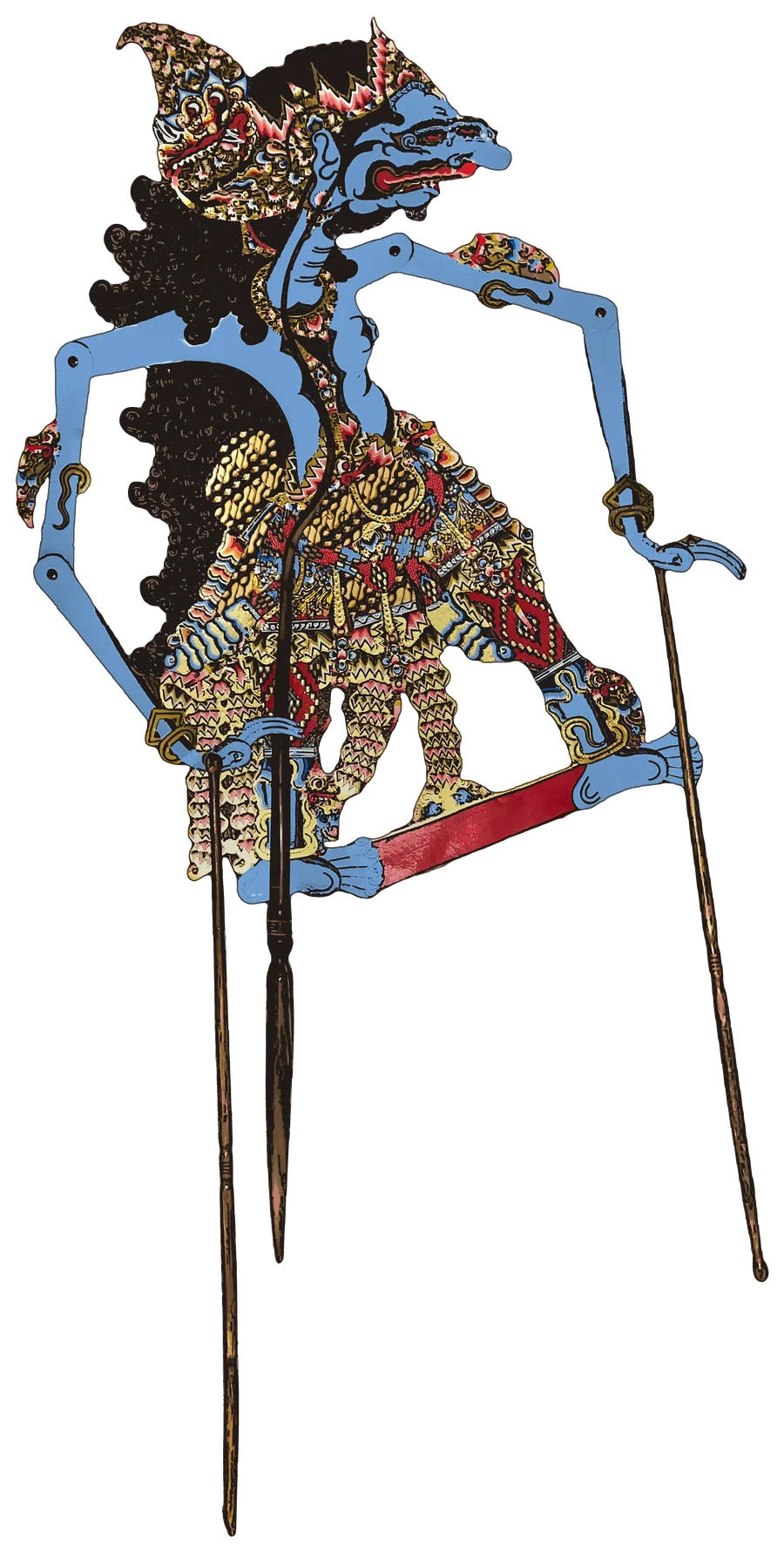
A wayang kulit purwa puppet is cut from one sheet of buffalo hide, then carved (tatah) and painted (sungging). Head, body and legs are one piece; the two arms are made separately and joined at shoulder and elbow with pins (gegel), so they can move. A central horn rod (gapit) holds the body from below up to the head, and each hand has a small rod for moving the arm.
The parts marked on the puppet above:
- Headdress (makutha) · The crown and its swept-back ornament are chiselled from the same piece of hide as the head. Headdress shape signals rank, so it is one of the first things used to tell figures apart.
- Face (wanda) · A character is recognised by its profile: the eye, nose and mouth shapes, the tilt of the head and the face colour. One character can have several variant moods, called wanda, for different scenes.
- Hair (rambut) · The black mass of curls behind the body is the figure's hair, cut as open spirals so the lamp light breaks through it on the screen.
- Arm joints (gegel) · The arms are cut separately and pinned at the shoulder and elbow, so the dalang can make the figure point, gesture and fight. Drag a hand or an arm rod on the figure to try it.
- Dress (dodot) · The lower garment carries batik-style motifs and gold detailing. Its fine perforations (tatahan) let points of light through, so the costume still reads as pattern in shadow.
- Ground (palemahan) · The red strip between the feet is the ground the figure stands on. A wide, striding stance like this belongs to strong, assertive figures.
- Arm rods (gapit) · Thin rods fixed to each hand let the dalang move the arms while holding the puppet in the other hand. They are traditionally made of buffalo horn.
- Central rod (gapit) · The gapit runs up the middle of the body and ends in a point. Between scenes the dalang pushes it into a banana trunk (gedebog) at the foot of the screen to stand the figure up.
Wanda
Wanda is the face and bearing that show a character’s mood. One character can be made in several wanda, for calm, sad or angry scenes, and the dalang picks the one that suits the scene.
The differences can be small: a slightly different tilt of the head, the shape of the eyes, the curve of the shoulders or the face colour. That is why the wanda is recorded together with the character’s name, as with the puppets in this collection.
Face colour
The face colour does not show skin colour but character and mood. As a rule of thumb:
- black: calm, mature and steadfast;
- gold (prada): noble and beautiful, often the most formal look;
- red: brave, quick to anger, or ruled by desire;
- white: young, pure or honest;
- blue and other colours: used for particular figures, including many sabrangan (overseas) kings and ogres.
These meanings are a guide, not a fixed rule: the same colour can mean different things in different gagrag and from different makers.
Eyes and nose
The shape of the eyes and nose sets refined figures apart from strong figures and ogres.
- liyepan eyes, narrow and half-closed: refined, calm figures;
- kedelen eyes, shaped like a soybean: strong figures;
- thelengan or plelengan eyes, round and staring: rough, fiery figures and ogres.
The nose follows the eyes: thin and pointed on refined figures, larger and rounder on strong figures and ogres.
Posture
A bowed head (tumungkul) marks a calm, humble figure; a raised head (langak) a proud or fiery one.
The legs speak too. Feet close together mark a refined figure; a wide stance, like the Sabrangan puppet above, marks a strong, forceful one.
Carving and painting
Tatah is the work of perforating the hide with small chisels. Its patterns, from fine dots to rows of tiny diamonds, let the light of the blencong lamp through the puppet, so its shadow on the kelir screen still carries the pattern.
Sungging is the painting that follows: colours are laid in steps from light to dark, then chosen parts are gilded (prada). A puppet’s quality is judged by the neatness of its carving and the fineness of its painting.